

Not long ago I would privately have judged anyone who ran their LinkedIn posts through ChatGPT before publishing. Then I started using AI a lot more actively, decided there was nothing to be ashamed of, and told myself we would all get comfortable with it soon enough and to stop pretending otherwise. That is where I assumed things would settle.
But it hasn’t settled there for me. A certain kind of post now makes me wince the moment it loads. The confident set-up-and-pivot opener; the ‘simple test you can do right now’; and, of course, ‘that isn’t an X problem, that’s a Y problem’.
With Claude presenting me with those same patterns multiple times a day, the recognition and repetition have become more and more obvious, and I’m sure I’m not alone in my reaction to it.
Yet the answer is clearly not “stop using AI”.
That’s one genie who will not be going back in the bottle.
So we have to find a middle ground, because AI is very good at producing words. It’s just making sure those words are worth reading, and that means using your experience, your stories, opinions and judgement, your own sense of humour, tone and style.
That’s what lifts your content far above the influx of AI slop.
So, should you use AI for LinkedIn content?
AI can be a valuable tool for creating LinkedIn content, helping with brainstorming, structuring ideas and drafting posts. However, effective LinkedIn marketing still depends on human insight, original perspectives and an authentic tone of voice. The strongest approach combines AI efficiency with personal experience, creativity and editorial judgement.
Will LinkedIn penalise you for using AI?
LinkedIn’s recent addition of a “seems like AI slop” button (which, incidentally, has just been extended to comments) has people fearing that LinkedIn will throttle their reach as a punishment for using AI.
But when you understand LinkedIn’s definition of slop, those concerns can be quickly dispelled.
It views slop as content that looks polished but has no real substance, perspective or insight behind it.
That says nothing about whether a machine helped with the writing.
LinkedIn’s only concern is whether a post is worth anyone’s time – not how it came to exist – so there is no issue with AI-assisted posts so long as they carry a real point of view.
The fact that more than a million people pressed the AI slop button in its first two weeks also tells us that, actually, this isn’t driven by the platforms, but by the readers themselves. People have had enough of empty posts and are voting to see fewer of them. Anyone producing that kind of content needs to change strategy, pronto.
Why does so much AI writing sound the same?
Good prompting isn’t enough to override how LLMs work.
It helps, absolutely. But AI was trained to behave in a certain way and to use the specific writing structures it was taught are the marks of a good answer.
And the contradiction is that those patterns are (or were) genuinely good. Models are trained on an unfathomably large amount of data showing what great LinkedIn content looks like, and then further tuned based on human ratings.
LLMs are impersonating great copywriters (hence all the professional copywriters of the world having to declare that they definitely used em-dashes long before ChatGPT existed). They are predicting the most likely next word and gravitating towards their training to find the average.
But this instinct is the opposite of a great copywriter.
Great copywriting stands out precisely because it’s different. It has an element of surprise. It has personality and is never afraid to take a risk.
It’s a craft that takes skill and many years of practice, and one that AI is fundamentally incapable of.
The shape of Ryan Levesque’s chart on ‘The shape of Enshittification’ says it all. Humans use unexpected words with far more regularity than any AI model.
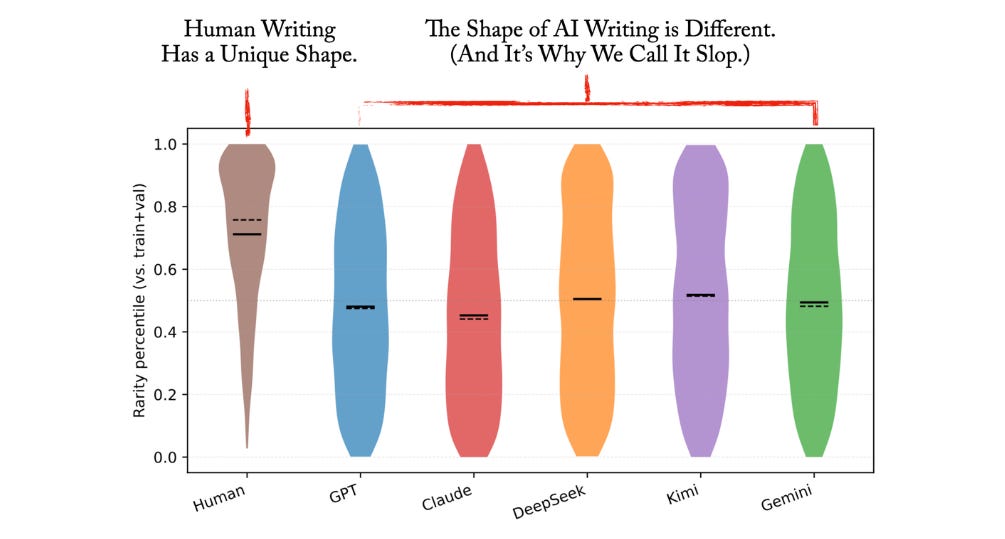 What you are left with is a tool that is superb at handing you a competent answer, but pretty hopeless at handing you one that stands out.
Can people actually tell?
Increasingly, yes. The average person on LinkedIn spends many an hour reading a chatbot’s output and you pick up its habits without ever meaning to. Those same habits stand out like a sore thumb when you spot them in your feed.
The more AI writing there is about, the sharper the reflex gets.
Rather than list out the tells that have me cringing, I’ll let Rob Mayhew do it for me. In just over a minute he manages to get through the full catalogue.
In contrast to this, there are a few people I follow on LinkedIn whose content is increasingly standing out to me precisely because it is so clearly them. I see a post belongs to them and I immediately know it will be worth my time.
There’s an opportunity here to really establish a reputation as a brand or an individual worth following.
Is AI turning everyone into a corporate brand page?
We’ve all heard someone say that organic social doesn’t work. That posting to company LinkedIn pages is aimless, if not altogether futile.
I’ve always rejected that notion.
The reason company pages don’t perform is nothing to do with them being company pages per se. It’s because of how they are used – sharing company news and updates that might resonate with their employees, but no one else.
Meanwhile, individuals are doing something very different with their profiles. Sharing personal stories and taking strong stances on the issues of today. The kind of thing that gets people replying and makes social media “social”.
At OST, we spend our lives trying to get brand pages to sound more like those individuals. We extract those stories and opinions to position brands as true thought leaders.
AI, it seems, is trying to do the reverse.
It drags a distinctive voice down towards the corporate average. That means a sharp personal profile, or an exec with something meaningful to say, has the most to lose.
Rather than faceless brand pages becoming more like engaging senior execs, those senior execs risk losing their identity and broadcasting into the void.
So… how do you use AI without sounding like everyone else?
I often talk about the importance of the AI sandwich.
Everything starts and ends with real human input, and AI only touches the bits in between.
That means the initial ideation comes from you, in just the same way it always has. An anecdote, a question a client asked, a result that surprised you, a mistake you learned from, or an opinion that goes against the grain.
The AI sandwich: How to use AI for LinkedIn content
1. Start with human insight
Begin with your own ideas, experiences, opinions or industry observations. Give AI something meaningful to work with.
2. Use AI to develop the content
Use tools such as ChatGPT or Claude to organise your thoughts, explore different opening hooks or create an initial draft.
3. Finish with your own voice
Review the output, challenge generic wording and add your personality, judgement and natural writing style before publishing.
Then hand this over to your LLM with clear parameters.
Ask it to organise your thoughts into clear sections or bullet points, to suggest some different opening hooks, or to turn your notes into a first draft (voice notes are perfect for this).
Those will set you on your way to producing something far more authentic than “write me a LinkedIn post about AI”.
But, even if it is well trained in your tone of voice, you still have to finish the process by putting back the thing that only you have: Your personality.
I’ve often been tempted to give it the benefit of the doubt. To conclude that it’s probably better written than I would have done it myself.
And whilst that might work perfectly well for an essay or a report, I’ve come to realise it won’t wash on social media. If you end up using wordplay and phrases that feel alien to you, that’s because you now sound like everyone else.
As my friend Claude would say: This was never really about AI. It was about connection, community, and showing up as your authentic self.
Frequently Asked Questions
Is it okay to use ChatGPT to write LinkedIn posts?
Yes. AI writing tools can help generate ideas, structure content and draft LinkedIn posts. However, relying entirely on AI-generated content can lead to generic messaging that lacks personality. The most effective approach is to use AI as a writing assistant while maintaining your own experiences, opinions and tone of voice.
How can you make AI-generated LinkedIn content sound more human?
Start by giving AI original material, such as personal experiences, industry observations or examples from your work. Once you’ve generated a draft, review it for repetitive phrases, unnatural wording and generic statements. Adding your own perspective and editing the content to reflect how you naturally communicate can make LinkedIn posts more authentic and engaging.
Can AI help with LinkedIn thought leadership?
AI can support LinkedIn thought leadership by organising ideas, improving clarity and speeding up content creation. However, genuine thought leadership depends on original insights, professional experience and informed opinions. For senior executives and B2B brands, AI works best when it helps communicate existing expertise rather than attempting to create that expertise from scratch.
